|
Home Page
Board Members
Organization Members
Join Us
Grant Info
Meetings
Capitol Happenings
What's Rural in OR
Rural Hospitals
Rural Hospital Report
Rural Health Clinics
Recruitment in OR
Training Opportunities
Bylaws
Rural Health
Other Resources
|
|
Getting There
Quicker
Community Health Improvement
BY: PAUL B.
MCGINNIS
Jerry Nickell
doesn't usually start his morning commute at 4:30 am to travel the
14 miles from his home to the hospital in Baker City, Oregon. But on
September 1, 2005 Jerry had to start early because his unicycle
could only carry him so fast.
Jerry is the
vice president of Mission & Human Resource for St. Elizabeth Health
Services and a member of the Baker County Community Health
Improvement Partnership (CHIP).
He rode the.
unicycle to promote leave Your Car at Home Day. “The year prior I
walked. It took me three-and-a-half-hours, and I had to get there
quicker this year.” Getting THERE quicker, wherever THERE may be, is
one of many reasons Oregonians and other Americans waistlines are
growing. Obesity experts say our dependence on motor vehicles for
short trips, a lack of safe walking and biking environments,
sedentary lifestyles and eating on-the –go all contribute to the
obesity epidemic
In February of
2003, the Oregon Department of Human Resource’s Health Promotion and
Chronic Disease Prevention Section released two companion statewide
plans promoting physical activity and improved nutrition. The
Healthy Active Oregon plans called Oregonian into action and
provided simple, yet eloquent, guidance on evidence-based practices
that community residents could employ. Both rural and urban
communities throughout Oregon embraced the challenge and are
mobilizing and starting to create projects and programs.
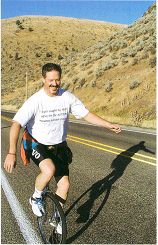
Jerry Nickell unicycles 28 miles
round trip during Leave Your Car
at Home Day. (Photo Courtesy of
the Baker City Herald). |
|
“No
single project or activity will solve the obesity
epidemic. It must be attacked on federal, state and
local policy fronts and in the community environments
where residents work and spend most of their time.
Individuals, in conjunction with their families, must
take responsibility for their own health,” said Jane
Moore, PhD head of Oregon Health Promotion and Chronic
Disease Prevention Section.
CHIP
is a comprehensive community health development model
coordinated through the Oregon Office of Rural Health.
During the past three years, several CHIP programs
throughout Oregon have decided to focus on "promotion of
physical activity" and "improved nutrition" as a means
to improve community health. Karen Bondley, CHIP
Coordinator for coastal Lincoln |
| |
|
|
County summed it
up this way, "the contributing behaviors to many of the leading
causes of death are diet, obesity and a lack of exercise. So, we
decided to focus some of our efforts in those areas."
The Lincoln
County
CHIP decided
to pursue a
policy path as well as implementing some community projects. They
sponsored two workshops attended by community leaders. The first was
an awareness raising session, which profiled all of the goals and
objectives in the statewide Healthy Active Oregon, plans and asked
participants to identify gaps between what was currently happening
in the county and what was called for in the plans. The second
workshop focused
on
nutrition and
exercise policies in public schools.
The Lincoln
County CHIP's community projects included scholarships for kids to
participate in Recreation Center activities, and Walk to School
events planned in conjunction with Lincoln County Public Health. A
more permanent project was the creation of a community garden in a
low-income housing complex. Master gardeners along with the local
Extension Service worked with the managers and residents to create a
large community vegetable garden. The twelve raised beds were
surrounded by strawberry plants to prevent erosion, and various
berry bushes and fruit trees. According to Debra Spoelstra of the
Community Development
Corporation of
Lincoln
County,
'This
Community Garden is providing low income families, seniors and youth
in our programs an opportunity to work together, mentor one another
and share in
a bounty of
fresh vegetables, food preservation and fun. The value of our garden
provides more than just good nutrition."
Each community
is unique and solutions that fit one might not make sense in
another. "One evidenced based strategy suggested placing signs next
to elevators prompting people to take the stairs. There are only a
few elevators in all of Baker County," said Barbara Tylka MD,
General Surgeon and Baker CHIP member. Tylka and a CHIP committee
created a resource inventory
of physical
activity opportunities and started a Why Not Walk? campaign to
discourage people from driving
three or four
blocks while going between stores in Baker City's historic downtown
district.
The Baker County
CHIP furthered its activities by applying for a grant from the
Catholic Health Initiatives community benefit program and created
Health in Action (HIA). Sherrie Kvamme has served as the HIA
Coordinator since its inception, and she has been busy. Over 1,500
people in Baker County (about 10% of the population) are registered
with the HIA program. There have been Walk Across Baker activities
where community residents tracked their walking distances and
plotted them on a chart that represented traversing the 100 plus
miles from Hells Canyon to the abandoned gold fields of Sumpter. HIA
also distributed pedometers, which have been shown to increase
physical activity by
 |
|
some
10,000 steps per day if used regularly The project has
expanded to Kids in Action, which through the public
schools promotes the ten healthy habits for kids to
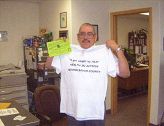
model. Rewards for "Getting Caught by HIA" doing
something positive for your health, include key chains,
T-Shirts, water bottles and other gifts, and are now a
hallmark of the HIA and KIA programs. |
Jim Thomas was seen
parking his
car in the furthest reaches of his
parking lot and walking an extra few
steps to work
|
|
In Richland,
Oregon (population 150), a part of Baker County where
the health care |
system is limited to emergency medical
services, a woman was told by her doctor she needed to lose some
pounds and suggested she join Weight Watchers. The problem is, there
is no Weight Watchers program in Richland and the logistics, cost,
and time spent getting to the nearest service made no sense to her.
Still she wanted to comply with her doctors request so she did what
many rural people do when confronted with similar situations, she
created her own set of common sense guidelines and recruited friends
and neighbors to a group called WAGs (Weight Accountability Group).
The WAGs meet Tuesday mornings, weigh-in, and talk about their
progress toward short and long-range goals. The WAGs do not endorse
a specific diet or exercise program. They support sensible
individual choices. The WAGs concept has spread to Halfway, Oregon
where a new group is forming.
The East Linn
CHIP embraced the active community environment strategy to promote
health. The Build Lebanon Trails (BLT) project was created as part
of the Trails Committee. Rod Sell, a City of Lebanon employee who
serves as chair of the committee said, "Our goal is to tie together
the community of Lebanon with a trail system that connects each
school, public building, park, the hospital, neighborhoods and the
business district." The long range vision is to build 45 miles of 12
foot wide, paved, fully ADA accessible trails. As planned, these
trails would connect Lebanon to other communities in Linn County and
beyond. This is an ambitious plan but local government, residents
and businesses have come together to "share the vision." Public
meetings were held to develop a matrix to prioritize which of the
over 60 trail segments would be pursued and in what order. The first
segment is called the Marks Slough Trail and makes the scenic
waterways in the community more accessible. 'Trails are the greatest
asset to any community and nature is all around us. With trails we
can embrace all the great outdoors Oregon offers, and we can get fit
and stay healthy in the process," said Sell.
 |
|

The Ridge Garden Club
members enjoy the fruits of their labor. |
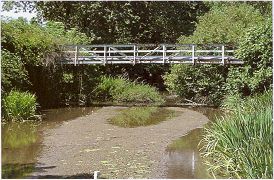
An Abandoned overflow pipe will be
converted into a
walking and biking bridge as part of the Build Lebanon
Trails plan. |
|
|
Just up the road
from Lebanon, Craig Martin, City Manager, Sweet Home, Oregon and
East Linn CHIP member has targeted his Healthy Active Oregon efforts
to his own workplace. Sweet Home employees now receive comprehensive
employee health screenings, telephone health coaching consultations
for those who want to change behaviors, walking competitions between
departments using pedometers, and the "Monday Munchy" program which
provides healthy alternative snacks in employee break areas. "The
efforts here have raised employee awareness that their individual
behaviors can indeed have an impact on our insurance costs, while at
the same time helping them be healthier and more productive," said
Martin.
The CHIP's in
Baker County, Lincoln County, and Reedsport determined to give their
local doctors a resource to help individual patients in need. Weight
loss counseling is not a service covered by many insurance plans so
these communities created Health Coach positions. These lay
residents were trained in Motivational Interviewing techniques an
emerging field with the intent of helping the client resolve
ambivalence around barriers to their goals. Clinicians in all three
places can refer patients to a Health Coach for up to three hours of
one-on-one service. Health Coaching is a form of health education,
not medical treatment and is part of a selfmanagement program for
clients.
These community
efforts in rural Oregon through the CHIP groups demonstrate the
desire and ability among community members to help their own fellow
citizens improve their health. The obesity interventions in the
workplace, schools, and community combined with nutrition and
physical activity policies are all helping to achieve the goal of a
Healthy Active Oregon.
|